
By Liwordson Vijayabalan, CEO, Welcome Platform
Statistics Canada estimates 31 percent of Canadian workers are in jobs highly exposed to AI, in roles where it's more likely to replace them than help them. The World Economic Forum expects close to 40 percent of job skills to change by 2030.
I don't think communities are ready for that. Getting them ready is a bigger problem than one app can solve, and probably bigger than any one company. I'll leave that for another post.
But one piece of it lands on our desk. The Welcome Platform builds apps for economic development, and local jobs is one of the most-used features in the apps we've shipped. Residents come back to it week after week. That's the piece we can do something about.
There's a bit of an Uno reverse card in what that something is. We're reaching for AI to meet a challenge AI is creating. It also happens to be useful today, because finding the right work has never been easy. Matching someone's actual experience, skills and education to an opening that fits, close to where they already live, is something job boards were never built to do. We think AI can get closer.
A job board hands you your past
Every job board works the same way. You type a title, it returns listings with that title. A logistics coordinator sees logistics coordinator jobs. The system takes what you've done and hands it back to you.
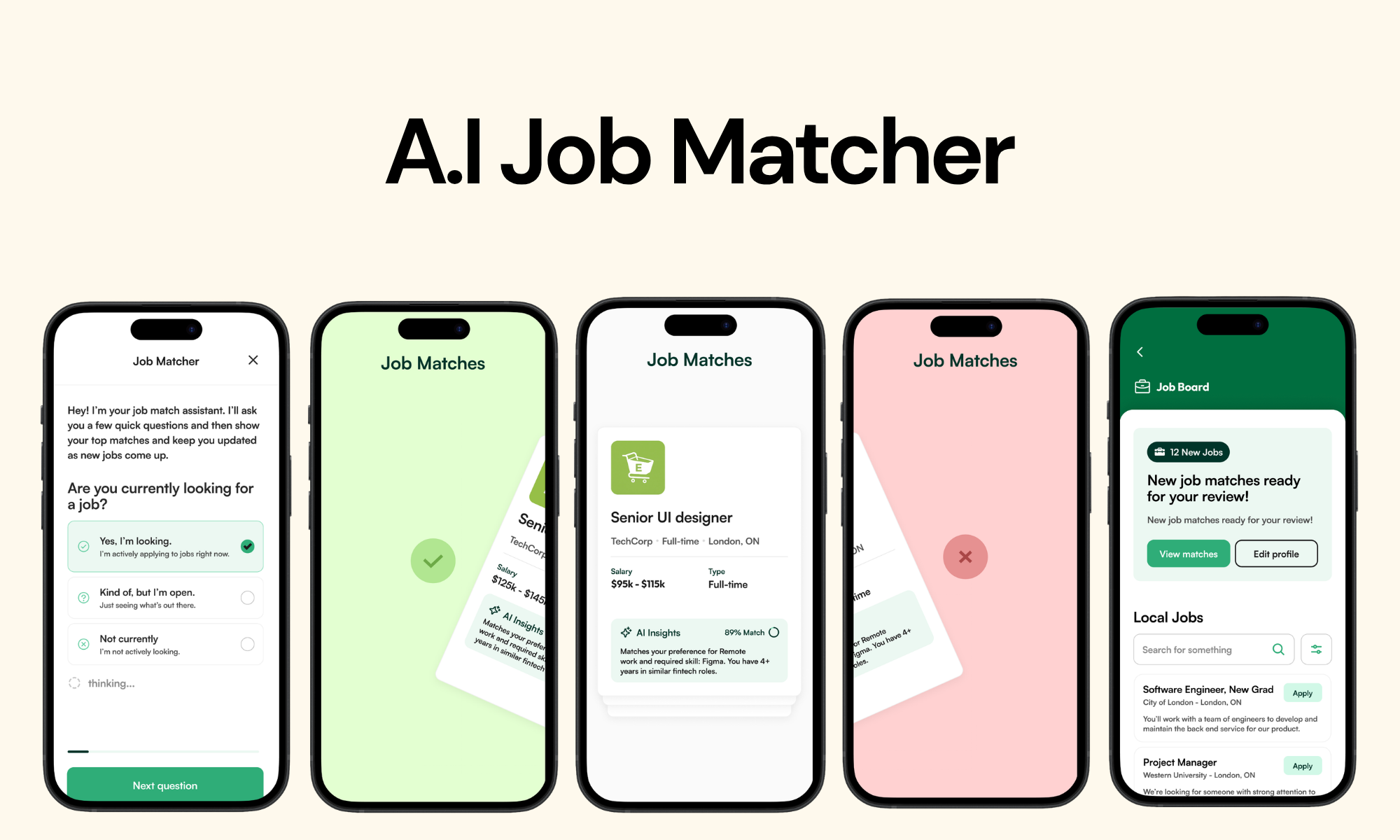
We built the AI Job Matcher to start from where someone wants to go. We still collect education and work history, but we also ask about goals and skills, and the matcher scores openings against all of it. Sometimes that means recommending a job in a sector the person never searched, because the skills line up even though the title doesn't.
Where someone wants to go includes more than a job title. If they want to work in tech, the question is how to get them there from where they are now. If they want to move into business development, the matcher should be angling them toward it. And the environment matters as much as the role: hybrid or in the office, a fast-moving startup or a large stable employer, a place that promotes from within. That all goes into the profile, because a match that looks right on paper and wrong on culture is still the wrong job.
We don't know for certain this works the way we think it will. What we do know is that a recommendation outside the norm costs almost nothing to make and almost nothing to ignore. The downside is small. The upside is someone finding out that the healthcare administration wants exactly what they've been doing in a shipping office for eight years.
The thesis
Over time, we think the matcher will predict a good-fit job for someone better than they can themselves.
That's a big claim. The mechanism behind it is ordinary. Matches arrive one at a time and residents swipe, right if it's worth a look, left if it isn't. Anyone who's used a dating app will know the gesture. When a match is a no, they can also tell the in-app agent why. Wrong hours, wrong pay, wrong side of town, wrong kind of work. That reason is saved to their profile and the next round accounts for it. Every no makes the next yes more likely.
The second piece is look-alike profiles. When an industry transitions, a large part of the labour force with similar skills ends up looking for work at the same time. Once the matcher has learned what worked for people with that profile, it can make a confident recommendation to the next person before they've told us much beyond their work history.
Where this goes
Matching is the first half. The second half is helping someone make the move. A match into a new sector usually comes with a gap: a certification, a short training program, a support service that helps with the transition. We want the matcher to point residents to the local program that closes that gap, and eventually to introduce them to people in their own community who made the same career change. That's the version we're building toward.
A year in London
We launched AI Job Matcher in MyLondon a year ago. Since then, more than 500 residents have opted in. That number is bigger than it sounds. Opting in means completing a second onboarding inside the app, uploading a resume or building a profile in a chat, and telling us what you're open to. Five hundred people in one city chose to do that.
Over the same period we've sent more than 10,000 AI job matches, and residents have clicked through to apply on more than 1,400 job listings in the app.
We're pleased with that as a start, and we're now working on bringing the matcher to more communities across the country.
If you run an economic development or workforce organization and want your community to have an app with this in it, book a demo with our team. We'd like to talk.
---
Sources
- Statistics Canada, Experimental estimates of potential artificial intelligence occupational exposure in Canada, September 2024.
- World Economic Forum, Future of Jobs Report 2025, January 2025.