
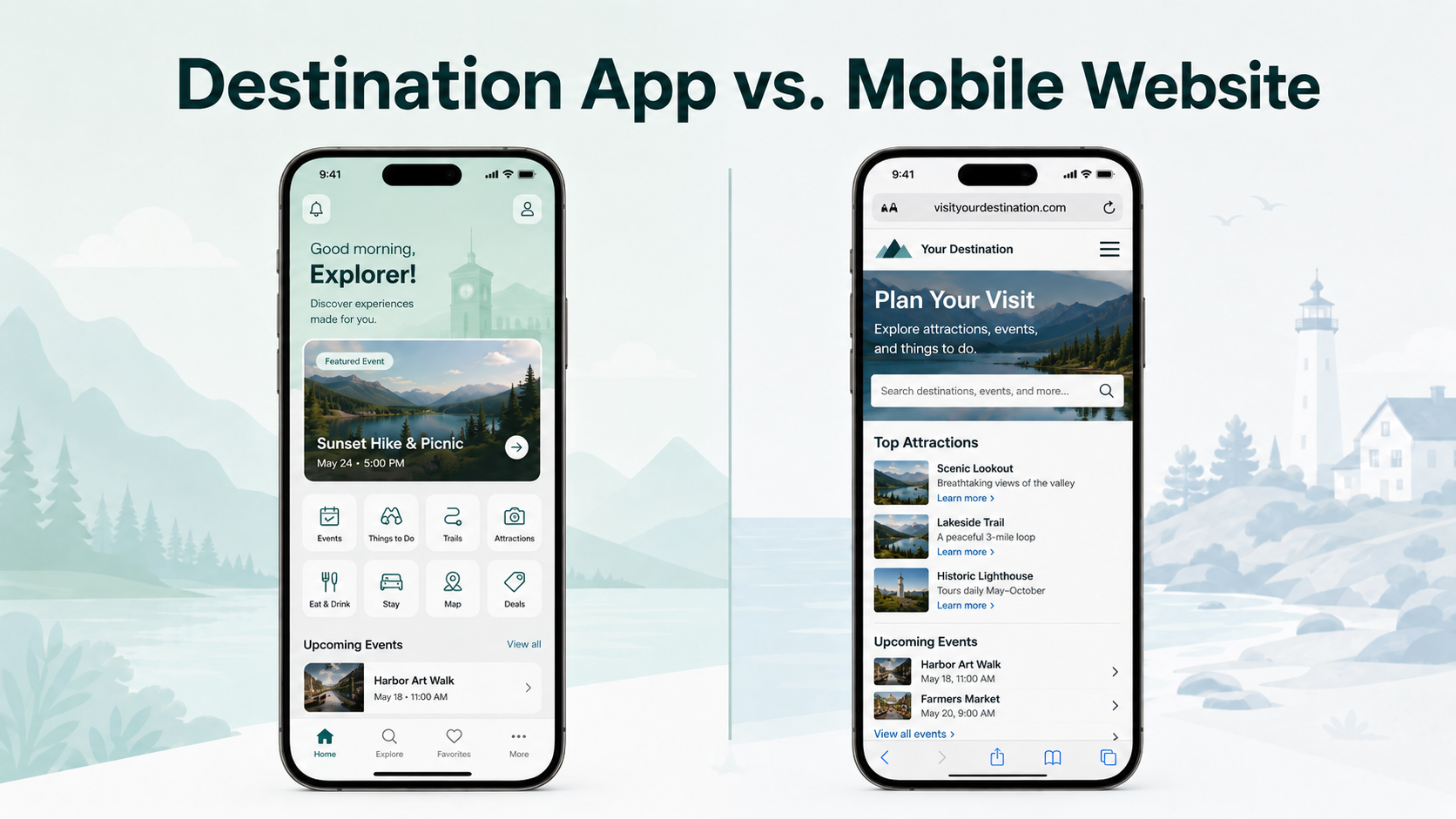
Tourism websites excel at pre‑trip discovery; destination apps excel in‑destination. This guide compares a destination app vs. mobile website so DMO leaders can choose based on outcomes: stronger partner visibility at decision time, easier discovery of local businesses like restaurants and shops, repeat access from the home screen, and re‑engagement between trips.
Destination App vs. Mobile Website: What’s Better for Tourism Organizations?
If you lead a DMO or tourism team, you’re weighing two approaches: rely on your mobile website, or add an app built for in‑destination use. The goal is to turn planning interest into local exploration, partner visibility, and spending once people are on the ground—while staying connected with opted‑in visitors between trips.
What is a tourism website designed to do—and for whom?
A website is built for discovery before the trip. It helps potential visitors compare regions, browse signature experiences, and get the basics—how to get here, where to stay, marquee attractions, and itineraries your team has published.
It serves search‑driven planners, media and travel trade, and residents looking up reference information. It works on any device and is straightforward to maintain as your primary public presence. In market, people can still use your site on their phone, but it often takes more tapping to surface what’s nearby, open, and worth doing right now.
What is a destination app designed to do—and for whom?
A destination app is mainly built for in‑destination moments. It helps visitors orient themselves, find what’s nearby, see what’s on today, and act quickly—where to go, how to get there, and what’s open. Strong destination apps prioritize speed and context: quick taps over deep reading, map‑first views, “near me” and “open now” filters, and clear paths to tickets, hours, and directions.
It also supports pre‑trip choices—letting people preview what’s happening on specific dates and explore neighborhoods—so travel dates, lodging location, and length of stay better match what they’ll actually do. Early install means your on‑the‑ground guide is already in a visitor’s pocket on arrival.
Between visits, opted‑in travelers can receive timely updates about seasonal highlights, new openings, and upcoming festivals—keeping your destination top‑of‑mind, giving partners a year‑round placement channel, and encouraging repeat trips.
How should a DMO compare these options?
Compare a tourism app and a mobile website against outcomes that matter:
- Visitor moments: pre‑trip research, in‑destination decisions, and between‑visit re‑engagement.
- Local discovery signals: near me, open now, today’s events, and timely deals.
- Partner value: visibility at decision time and placements you can describe clearly at renewal.
- Content cadence: updates your team and partners can realistically sustain.
- Adoption dynamics: zero‑install browser vs. installed, home‑screen access and notifications.
- Total cost to launch and maintain, relative to the business outcomes above.
What does a destination app make easier than your mobile website?
| What matters in‑market | Mobile website reality | What a destination app makes easy |
|---|---|---|
| Partner visibility at decision time | Strong for featured stories and static listings; visibility depends on prior discovery | Puts partners beside actions—map, hours, directions, book—at the exact moment visitors choose |
| Nearby discovery | Category pages and search help, but little instant context for what’s close now | Location‑aware browsing with Near Me, Open Now, and map‑first views |
| Today’s events | Listings exist; visitors must find and filter them | One‑tap view of what’s on today or this week to plan before they head out |
| Timely deals | Static offers pages are easy to miss | Shows current local deals right when people are deciding where to spend |
| Updates and alerts | Pull‑based: people return via search, social, or email | Opt‑in notifications for time‑sensitive information |
| Repeat access | Opens in a browser each time; sessions are often one‑and‑done | Lives on the home screen for quick checks throughout a trip |
| Re‑engagement between trips | Relies on rediscovery through campaigns | Keeps opted‑in visitors aware of seasonal highlights and new openings |
| Content cadence | Suits evergreen content and seasonal guides | Suits frequent updates to events, hours, and offers from staff and partners |
| Primary visitor moment | Best for pre‑trip research; usable in‑destination with more tapping | Built for on‑the‑go decisions and wayfinding with fast, tap‑light paths |
Both play a role. If in‑destination activation is a priority, weigh the app column more heavily while keeping the website as your brand and research hub.
Where do the two work together rather than compete?
They complement each other. Your website attracts and informs before the trip; your destination app becomes your on‑the‑ground guide where hour‑by‑hour decisions are made, and helps you re‑engage opted‑in visitors between visits.
A simple pattern: the website promotes the app for in‑destination use, and the app links back to deeper web content for research‑heavy needs and seasonal planning.
Where Welcome Platform is a strong fit
If you decide you need in‑destination support without building from scratch, Welcome Platform is practical digital infrastructure for local access, discovery, communication, and engagement.
- In‑destination engagement that drives local spending: Welcome Platform supports local deals and promotions and local events so visitors see current offers and what’s on when they’re deciding where to go. For your organization, that puts partner activity closer to the moment of purchase.
- Year‑round partner visibility you can describe at renewal: Welcome Platform supports partner, sponsor, and local business visibility, so partners appear alongside decisions—not buried in static pages—making value easier to explain to boards and members.
- Up‑to‑date, easy‑to‑browse directories: Welcome Platform supports local business directories and local events, bringing listings into one place that’s simple to scan by category or relevance. For staff, scattered information consolidates; for visitors, finding options takes fewer steps.
- Better on‑the‑ground visitor experience: Welcome Platform supports destination information for visitors and AI‑assisted answers about local information, so people can orient quickly and ask questions in their own words instead of hunting through pages. That reduces drop‑off when someone just needs “what’s nearby” or “what’s happening today.”
- Staying relevant between visits: With events, offers, and destination information in one place, Welcome Platform gives you content that remains useful after the trip—so opted‑in visitors have a reason to check back for seasonal highlights and new openings.
Explore how this applies to your priorities on the Tourism solution page and the Destination apps page. For program ideas across seasons, see the Events / trails / local discovery pages and the Partner visibility page. If you want examples from peers, review Related destination launch updates.
Frequently Asked Questions
Do we have to rebuild our website if we add an app?
No. Keep your website as the planning and brand hub. Use an app to handle in‑destination discovery and decisions. They work together.
How do we drive adoption of a destination app?
Promote it at natural touchpoints: pre‑arrival email, your website’s visitor pages, QR at visitor centres and partner venues, and event signage. Make the in‑market value obvious: what’s on today, nearby food, and local deals.
What content cadence does an app require?
Plan for weekly updates to events and offers during busy seasons and periodic checks on hours and seasonal categories. Align this with partner workflows to keep it sustainable.
Can we start small and expand?
Yes. Start with core events and business listings, then add deals or seasonal campaigns once partner workflows are established.
How does this help partners and sponsors?
They gain visibility at the exact moment visitors decide where to go, which is easier to explain at renewal time than impressions from a static directory page.
Next step
Learn how Welcome Platform helps communities make local information easier to access. If in‑destination support is on your roadmap, explore the Tourism solution page and Destination apps page, then connect with us on the Contact or demo page to discuss scope and timelines for your destination.